RylieSenatorsFour year old Rylie Maginn recently received a very important invitation! Invited by Pennsylvania Senator, Lisa Boscola, Rylie and her family visited the state capital building in Harrisburg on September 23, 2013 to advocate for Pitt Hopkins Syndrome. Senator Boscola gave a warm introduction of Rylie on the senate floor as she spoke about her early diagnosis, our online support group, and the recently formed Pitt Hopkins Research Foundation. Rylie was welcomed by all of the senators with a round of applause! Later a resolution was adopted declaring September 18th Pitt Hopkins Awareness Day in the Commonwealth. We sincerely thank Senator Boscola for taking the time to bring awareness to Pitt Hopkins Syndrome. Also, a big thank you to Rylie for being such an adorable ambassador for our Pitt Hopkins Family!

Video link of Senator Boscola welcoming Maginn family to the senate floor, September 23, 2013:

http://www.senatorboscola.com/wp-content/uploads/2013/09/BoscolaPitt.mov www.senatorboscola.com


Audio link of resolution being read to senators, September 23, 2013:

http://www.senatorboscola.com/media/audio


International Day of Recognition for Pitt Hopkins, September 18, 2013

By Taylor Hammerl | September 18, 2013
Permalink – International Day of Recognition for Pitt Hopkins 

Imagine a life in which your child is unable to walk or speak.  A life in which you can’t begin to know what your child is thinking or feeling.  Parents of children affected by Pitt Hopkins Syndrome live this life every day.  But after years of uncertainty, scientists and researchers are providing hope to these families.  And it all starts with awareness.

Today, September 18th, is the first International Day of Recognition for Pitt Hopkins Syndrome.  Pitt Hopkins is a rare neurodevelopmental disorder caused by a spontaneous mutation on the 18th chromosome. While many of us can’t be sure exactly what that means, hundreds of families understand it all too well.

The Day of Recognition is supported by the Pitt Hopkins Research Foundation (PHRF).

Their mission is to support research dedicated to finding a treatment and eventually a cure for Pitt Hopkins and other similar disorders.

Quicken Loans team member, Jennifer O’Connor and her 13 year-old daughter are familiar with the effects of Pitt Hopkins.  After years of failed diagnostics, Jennifer is finally getting some answers about her daughter’s potential diagnosis and she finally has hope for progressive therapy and treatment. Jennifer’s wish:

Sid n friends

“All I want is for her to say I love you and give me a hug.”

To date, more than 250 people have been diagnosed with Pitt Hopkins.  And with the recent discovery of the gene in 2007, there are likely many more that remain undiagnosed.

If you would like to join us in raising our level of awareness, check out www.pitthopkins.orgto learn more about living with Pitt Hopkins and ways to support the foundation!


BBC

BBC NEWS, WALES

Isabella Groves’ parents urge awareness of Pitt Hopkins syndrome

Elen Wyn reports, September 20, 2013

A three-year-old girl from Denbighshire who suffers from a rare genetic condition has defied doctors’ predictions and started to walk.

Isabella Groves, from Saron near Denbigh, is one of only 250 people in the world who has Pitt Hopkins syndrome, which can cause mental retardation, epilepsy and intestinal problems.

Her parents, Leanne and Andrew, want to raise awareness of the condition. They believe there are probably more children who have the illness, but have not been properly diagnosed.

Elen Wyn reports.

The first annual Pitt Hopkins Awareness Day was celebrated around the world this week, September 18, 2013.

Please visit the new Pitt Hopkins UK website:  http://pitthopkins.org.uk


Families from around the world celebrated the first annual Pitt Hopkins Awareness Day on September 18, 2013.  Thank you to all PTHS families for your love and dedication.

http://www.petoskeynews.com/news/featured/pnr-a-happy-life-despite-rare-diagnosis-petoskey-family-moves-forward-20130919,0,2573908.story

A happy life: Despite rare diagnosis, Petoskey family moves forward

Rachel Brougham (231) 439-9348 – rbrougham@petoskeynews.com, September 19, 2013

COURTESY PHOTO
His giggles are contagious. Once Zander Tewksbury, 2, starts laughing, his mom can’t help but laugh along with him.

And as they cuddle together on the couch, Krystal Middaugh tickles her son’s belly even more. Happy laughter fills their Petoskey apartment.

“He’s just a happy little guy, always so happy,” Middaugh said over the laughter.
“This kid doesn’t have a choice, but his life is perfect for him.”

At first glance, Zander might appear to be like any other 2-year-old. He plays with his toys in the corner of the living room. He bounces in his jumper. He loves being in his mother’s arms. He adores his big brother, Kaden, 6.

But that’s where the similarities end.

Zander may never walk on his own. He may never speak more than a few words. He may never learn to go to the bathroom on his own. He may never feed himself. Zander will need assistance for the rest of his life.

In July, just four days after his second birthday, Zander was diagnosed with an extremely rare syndrome known as Pitt Hopkins.

Pitt Hopkins Syndrome is a genetic disorder affecting a specific gene in chromosome 18, called TCF4. The syndrome is characterized by intellectual disability and developmental delay which can range from moderate to severe and include breathing problems, recurrent seizures and epilepsy, gastrointestinal issues and distinctive facial features. Many diagnosed with Pitt Hopkins never learn to walk unassisted and typically do not develop speech skills — some may learn to say only a few words.Krystal Middaugh holds her 2-year-old son, Zander Tewksbury. In July, Zander was diagnosed with Pitts Hopkins syndrome, a rare genetic disorder which causes extreme developmental delay and intellectual disability.
While overall prevalence of Pitt Hopkins Syndrome is unknown, estimates put the number of patients at only about 250 worldwide.

“That week of his birthday was a rough one,” Middaugh said.

“It was really hard. He’s not 2-years-old to me because he can’t do anything a 2-year-old does. And when the diagnosis came, I realized that no matter what I do to help him, it won’t fix it.”

Middaugh said she and Zander’s father, Neil Tewksbury, knew very early on that something wasn’t right when Zander wasn’t progressing like the other children his age. He wouldn’t roll over, play peek-a-boo or crawl.

At first, the family and doctors chalked up his lack of developmental advances to asthma, which he was diagnosed with as an infant. But still — developmental milestones never came. Doctors ruled out autismand Down syndrome. They were referred to a specialist downstate, and after a series of tests, the diagnosis of Pitt Hopkins finally came.

“They told me Zander has a more severe form of a mental disability,” Middaugh said. “If he does walk, it won’t be before he’s 7. Potty training and self feeding is a maybe.”

While the diagnosis meant the family could understand Zander’s developmental delays and struggles better, it also meant the family now must focus on what they can do to help Zander as he gets older.

He currently attends therapy five times a week where he works on speech and muscle development. He’s moved up into a room with toddlers at his day care so he can be around children his own age. And Middaugh is working on how she will make their new home more accessible for Zander.

The family will be a partner family with Habitat for Humanity in Emmet County, with groundbreaking expected this fall.

“The house will help us a lot, but there are things we will need to do on our own to really help with Zander’s development,” she said.

“We really need to fence in the backyard. It’s not like he can wander off, but we have to protect him from what could come in — like a dog. And hopefully get a wheelchair accessible shower and just do things to make it as comfortable and easy for him as possible as he gets older.”

A benefit will be held from noon to 6 p.m. Sunday, Oct. 27, in the Petoskey High School culinary classroom. The spaghetti dinner will also feature a bake sale, silent auction and a raffle. Entry is by donation.

All money raised will help the family with medical expenses and for house upgrades to help Zander learn to be as independent as possible as he gets older.

“Before I had Zander, I never thought I’d be able to take care of a special needs child,” Middaugh said. “But he’s a blessing. He’s taught me so much about myself and I hope others can learn from him. I can see all that is wrong but he’s perfect and I love him.”

Middaugh tickles Zander’s belly again. He giggles uncontrollably.

“He’s just so happy,” she said as she smiles at him and tickles him some more.

“I would have never picked this life for him, but he loves his life and I will always love this little angel.”

The Mirigliani family raises $2,888 for research with a lemonade stand on Pitt Hopkins Awareness Day, September 18, 2013, Matua Township, New Jersey!


Mantua family to raise money for Pitt Hopkins Syndrome research with lemonade stand

http://www.nj.com/gloucester-county/index.ssf/2013/09/mantua_family_to_raise_money_for_pitt_hopkins_syndrome_research_with_lemonade_stand.html

anthonymirigliani.JPGAnthony Mirigliani, 9, of Mantua, was born with Pitt Hopkins Syndrome, a rare genetic disorder characterized by motor, verbal and developmental disabilities.Photo courtesy of Claudette Mirigliani

 MANTUA TWP. — Claudette Mirigliani had been looking for an answer for six years when a doctor finally diagnosed her son Anthony with Pitt Hopkins Syndrome.

The rare genetic disorder, which is characterized by severe verbal and developmental delays as well as motor-skill problems, had been obvious from the beginning of her son’s life. No one had been able to pinpoint the cause of Anthony’s disabilities, however, until the family made a visit to Children’s Hospital of Philadelphia.

“That was my re-birthday,” Mirigliani said. “It was an answer to a question I’d had for six and a half years.”

The Mantua Township committee on Monday night declared today Pitt Hopkins Awareness Day. To honor the occasion, Mirigliani and her family will raise money for the Pitt Hopkins Research Foundation with a lemonade stand at their home.

Pitt Hopkins Syndrome is extremely rare, with only 250 people diagnosed with the disorder worldwide. But Mirigliani suspects that many more have been incorrectly diagnosed with cerebral palsy, the same way Anthony was for several years.

“This is why awareness is so important,” she said. When people try to guess Anthony’s condition, “A lot of people assume he’s autistic.”

Although Anthony, 9, loves to spend time with other children, he cannot speak, and delayed fine motor skills limit him to rudimentary sign language. He couldn’t walk until he was 2 1/2, and his mental age is only that of a 3- or 4-year-old. He needs help eating as well.

That doesn’t stop him from enjoying life, however. Anthony, who plays baseball, soccer and basketball in a league with other special needs kids, is a fixture around Mantua.

“He’s so happy,” said Mirigliani. “We go shopping, and everybody knows him.”

She hopes to raise awareness about Anthony’s condition and even enlighten the parents of other special needs children.

“We want them to know there’s a boy in the neighborhood with a rare genetic disease,” Mirigliani said. “If there’s somebody else out there and they don’t know what’s going on with their kid and I can help them, that’s groundbreaking for a parent. That’s the biggest thing: awareness.”

The Miriglianis will hold the lemonade stand at their home at 740 E. Atlantic Ave., Sewell, today after school hours.

For more information about Pitt Hopkins Awareness Day, visit pitthopkins.org.

Contact staff writer Andy Polhamus at 856-686-3729 orapolhamus@southjerseymedia.com

Mantua Township declares September 18th International Pitt Hopkins Day!


One in 200,000: my son and his rare syndrome

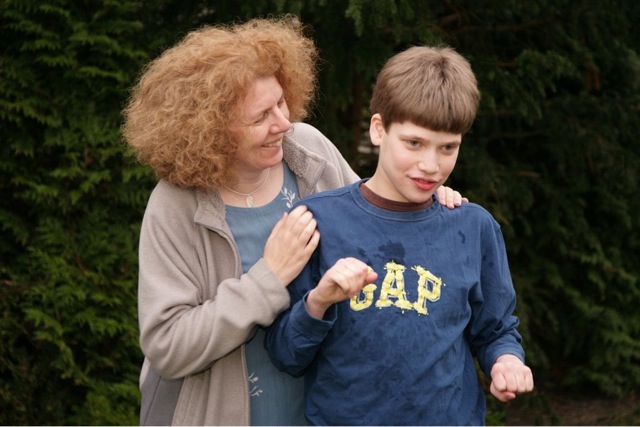
Christopher at 17, with Sue

Most doctors and geneticists have not even heard of the condition that my 21-year old son Christopher has – Pitt Hopkins Syndrome (PTHS). Christopher was probably the first British person to be diagnosed with Pitt Hopkins Syndrome with the first blood test developed for it. PTHS is a rare neurodevelopmental disorder caused by a spontaneous mutation on the 18th chromosome.

When Christopher was diagnosed the main rare disease charities hadn’t heard of it and only seven children in the world had ever been formally diagnosed with it before the blood test was developed.

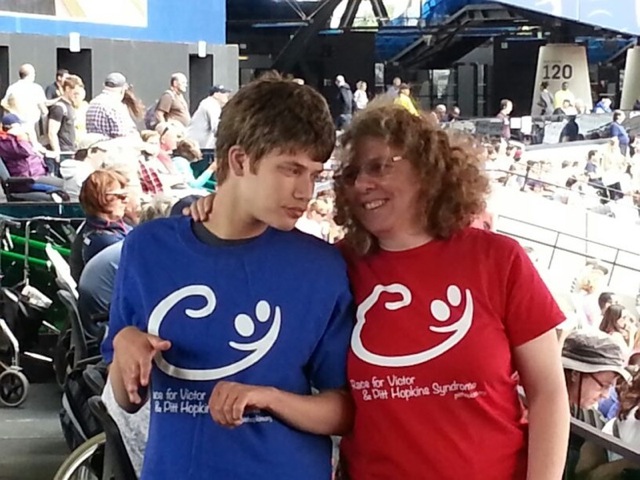
Christoper and Sue in July this year at the Olympics anniversary games

Today is the first annual international Pitt Hopkins awareness day (18th September, to reflect the relevance of the 18th chromosome) and the official launch of the UK support group’s website.

Today, nearly 300 families across the globe who are carers for young people with one of the most rare medical conditions in the world will be reaching out to try to find other people who have the same condition. We have produced ashort slideshow to help raise the profile and understanding of the condition. I am aware of 33 people in the UK with Pitt Hopkins Syndrome (PTHS). I believe that there could be as many as 250, as the incidence is thought to be 1 in 200,000 to 300,000.

This is a condition so rare that there are no official records of people who have the disease and geneticists who diagnose it are restricted by confidentiality from sharing patient specific information with all but close members of the families.

Yet for parents coping with the shattering realization that their child has a rare condition, sharing experiences, supporting each other and finding ways to help is absolutely essential – that’s why it often falls to the families of patients themselves to find and support each other.

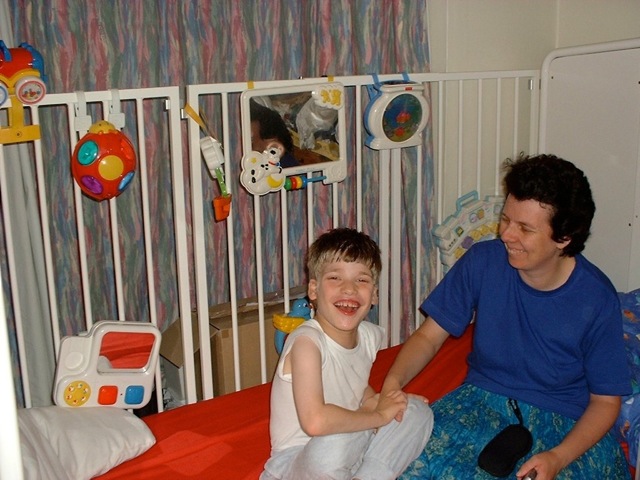
Christopher in his new bed, age 10

Christopher, who is 5ft 5in, has severe learning disabilities and in development terms is described as having the same physical and mental abilities as a toddler of 12 to 18 months. When he was diagnosed at almost age 16, I could find no one who knew anyone with PTHS. I put a message on a rare diagnosis website and almost six months later a mother in the States found it and we started our online support group. This was the first ever PTHS group.

When your child has a serious and rare disease, you’re desperate to get as much information as you can – information that can help your child. When literally no one can help – you find the determination to go and seek that information yourself.

I also feel it’s important that I share my positive experiences of how my husband and I have helped Christopher.

All through his life, my husband Brian and I have spent sometimes up to 5 hours a day working with Christopher to help him reach the normal milestones that you’d expect a baby and toddler to reach before age two.

Christopher learned to walk at the age of nine – which was a massive achievement for him. He learned to feed himself with a spoon at 11, and we are working with him getting to standing on his own. We’re trying to toilet train him. He can ascend and descend stairs or steps with supervision. Every small step is such a massive step for him, and for us. I feel it’s more rewarding for us as parents that we’ve had to fight for every small development. We like to say: “Never say never “ for Christopher.

I have met some wonderful families through Christopher. We want to reach everyone who knows a child with PTHS that we can. We want, of course, to reach the parents whose children are undiagnosed. We are using social media a lot to do this. You can reach a lot of people this way but there are still lots of families who don’t use social media, who don’t know how or don’t want to know how or just do not have the time. We are hoping to reach these parents through doctors, health centres, schools, daycares and other parents.

Each parent is doing this locally with their local health providers and raising awareness in local papers if they can.

We are a very small but very determined bunch of parents!

We are also raising awareness around the world to raise funds for research. Audrey, another mother, used her skills as a writer and journalist to find top scientists willing to start new research for us.

Dr David Sweatt, an US-based researcher into the mechanisms underlying learning and memory, has stated: “In essence, knowledge gained from studying the orphan disease PTHS would potentially allow broad understanding of a wide variety of learning and memory disabilities that afflict many families.”

We are very excited about the beginning of real research into finding a therapeutic approach to help our children. There are such exciting advances in genetics and neurogenetics and we are at the start of a long but pioneering journey.

In the UK, members of the International support group are fundraising too. We hope to send about £8,500 over soon towards the research. We are in the process of setting up a small charity – Pitt Hopkins UK.

The Dutch Pitt Hopkins group, founded in 2008, has funding to create a detailed ongoing questionnaire for Pitt Hopkins Syndrome. It is only in Dutch and English at the moment but we hope that it will be translated into other languages, as we make links across the world. This data will be indispensable to research and to everyone’s understanding of PTHS but can only be provided by those we know about and can invite to complete the online questionnaire.

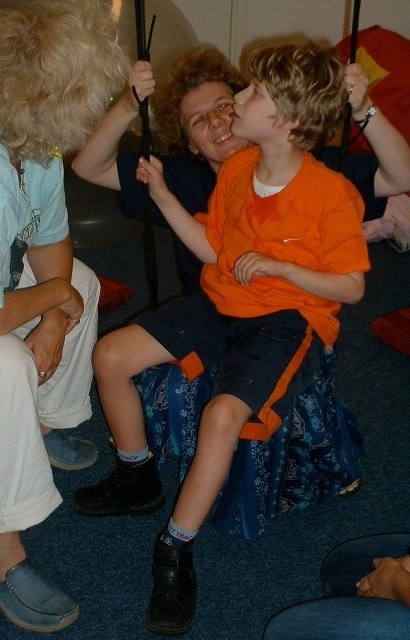
Christopher has sensory therapy at age 12

I also want to find those other mothers and fathers to tell them that having a child with a rare disease like Pitt Hopkins can be an overwhelmingly positive experience. Christopher is such a happy person with a great sense of humour, despite being non-verbal. I’m intensely proud of him and his achievements. Brian and I get so many more opportunities to celebrate his achievements than we would with a typically developing child.

I feel I have gained a lot from Christopher. I have learned a lot about brain development; I have learned when to say no, when to fight and when to let things go. I have learned to prioritise, I am stronger emotionally and I am more organised. I have learned that the best advocate for your child is you, their mother.

• For more information about Pitt Hopkins Syndrome, please see our websiteor go to Facebook
• Raise awareness of rare disease by clicking on www.raiseyourhand.co.uk


 “Liz is My Hero” by Judy Jennings (Pitt Hopkins Awareness Day 9/18/13)

http://www.makeahero.org/blog/liz-is-my-hero-by-judy-jennings-pitt-hopkins-awareness-day-91813/

September 18, 2013

Liz is my hero.

“Her journey through adaptive sports defines her persistence, determination, dedication, and concentration.

For most in this world, training and competing in four sports would be enough of a challenge. For Liz, this is just shy of a miracle.

Why?

When Liz was 6-9 months old, Liz was diagnosed with “failure to thrive”. At age 18 months old, Liz had a clinical diagnosis of Rhetts Syndrome, a degenerative syndrome resulting a loss of mobility, speech, eating, and fine motor skills.

At age 3, Liz was tested for appropriate educational programming and received a diagnosis of Autism, with communication and sensory integration severely affected. At age 6, a clinical diagnosis of Cerebral Palsy was added. At age 10, Liz it was also confirmed that she had Osteopenia in her feet. It wasn’t until Liz was 13 years old that scientist conducting a research study on genetics discovered that Liz has Pitt Hopkins Syndrome – all the other clinical diagnosis were dismissed.

Pitt Hopkins Syndrome (PTHS) is a rare genetic disorder affecting a specific gene in chromosome 18, called TCF4. PTHS is characterized by intellectual disability and developmental delay which range from moderate to severe, possible breathing problems of episodic hyperventilation and/or breath-holding while awake (55%-60%), recurrent seizures/epilepsy (40%-50%), gastrointestinal issues, and distinctive facial features.

At her time of diagnosis, she was one of the 250 people in the world with Pitt Hopkins Syndrome(PTHS). Many people with PTHS have challenges with ambulation and use a wheelchair for primary mobility.

In order to maintain ambulation, Liz has undergone 3 different surgeries, countless hours of physical therapy, and a plethora of orthotics. She received intensive Occupational Therapy for 10 years to address her sensory integration disorder, and continues to receive speech therapy to progress with and support communication.

Last night I talked with Liz about doing a blog to share her journey and how sports plays a huge role in her life. Liz’s response was “Yeah!”, with a confirmed head nod communicating yes. She then looked through pictures she wants you to see.

The first sport Liz participated in was adaptive swimming. Playing in the water has always been a love for Liz, but swimming was work…hard work. Liz’s right side of her body seemed to drag when she attempted to swim. She gradually began using both her arms.

After ten years of never giving up, Liz learned to swim independently. This last year she trained all year with her Special Olympic Aquatics team. She competed in the 25m, 50m, and 4x25m freestyle relay.

Liz started recreational therapy at Kopper Top Life Learning Center  at age two. She was determined to develop her muscle strength, keep her core muscles active, and to decrease her ataxia.  At the time, Liz was more interested in the sand beneath the horse than touching or even getting close to a horse.

She threw tack tools and screamed. After 12 years of perseverance and determination, Liz can now ride. For safety, she continues to need a “side walker” and they ride within a ring.

When we first saw her steer the horse through the barrels at practice, tears came to my eyes. Instead of clapping, laughing, and looking up at the birds and clouds, Liz was focused and determined to guide her horse! The smile of accomplishment said it all. She had faced another challenge and succeeded!

Liz loved sledding, and had overcome and healed from all of her foot surgeries, so this past year, Liz trained in Alpine skiing with me as her coach.

Skiing was difficult for Liz. She pushed through falling once and then began to take steps in the skis. With the amazing determination and support from a certified ski instructor with French Swiss Ski College, Liz went down a portion of the bunny slope!

At age 4, Liz began working on bike riding skills. Her biggest challenge was balance and steering. Throughout the years, she has learned to steer, and at age 9, started riding an adapted trike. September 7th, Liz qualified for the 500meter time trial by completing a 500m lap independently on her trike. This was the first year she did not stop for a break.

Her determination and concentration is inspiring to all who watched. Billy Quick, a World Class athlete and Special Olympian, came over to Liz to congratulate her.

He has seen her ride over the years and said, “You gotta be proud! She did great!” That night, Liz talked to me for over 10 minutes about the day. Mixed in with lots of expressive sounds and word approximation, one sentence was distinctly clear. She kept saying, “I go, Momma.”

Yes, you did, Liz!

Pitt Hopkins Syndrome will continue to challenge Liz throughout her life. There are breathing concerns, like apnea, and many restless nights of gastrointestinal pains and complications.

We have seen that when Liz is involved in sports, her symptoms are lessened. We hope that sharing her journey through adaptive sports and the many challenges of Pitt Hopkins Syndrome will be an encouragement for anyone else persisting to overcome obstacles in life! If Liz can “go”, we can too!

Thank you, Liz for being my hero.

If you would like to make a contribution in support of research for a cure and treatment to Pitt Hopkins Syndrome, please visit Liz’s website (inspired by her cousin), which can be found at the “Millie Loves Lizzy” website –> here.”


*** Make A Hero is a registered charity & 501(c)3, creating adaptive-sports films and media content, inspiring individuals with disabilities to enjoy the freedom of adaptive sports & recreation.

Please help us spread the word about Liz, and all other heroes, by sharing this post through the social media buttons on this page, liking Make A Hero on Facebooksubscribing to The HERO Newsletter on the right side of this page, and / or learning how you can make a hero.  Thank you! ***

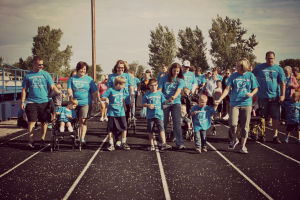
4 Boys Leading the WayThe Walk for Ian and Pitt Hopkins held on September 14, 2013 in Bedford, Iowa was a huge success! We will be donating over $11,000 that was raised for Pitt Hopkins Research!  We had an amazing turnout, 250 people which included 4 PTHS families!  We were so glad that Nolen Parkin (Jason and Kelly’s son of Urbandale, Iowa), Mason Skahan (Matt and Lesley’s son of Iola, Kansas), and Eli Adamson (Scott and Amy’s son of Baldwin City, Kansas) were able to join us!  The one picture is of the boys leading the first lap around the track…it was so inspirational to have them lead 200+ people in a lap for HOPE!

Walk Photo 2013


Pitt-Hopkins fundraiser a success

Pitt-Hopkins fundraiser

Posted on September 16, 2013, by Nick Johansen

(Bedford) — A fundraising event to raise money and awareness about a rare affliction was a major success.

Trevor and Jessica Fletcher, parents of 8-year-old Ian, was diagnosed with Pitt Hopkins Syndrome in 2008. The disorder causes seizures, breathing problems, and gastrointestinal complications in kids. The disorder is very rare, and currently, only 250 people in the world have been diagnosed. The Fletchers organized a walk on the Bedford School track to raise money for the continued fight.

Jessica Fletcher says with the help of Bedford and the surrounding communities they raised over $11,000 to donate to the Pitt Hopkins Research Foundation. 250 people joined in the walk, including two from Kansas and one from Urbandale. In addition three other boys with Pitt Hopkins Syndrome joined their son Ian and joined in enjoy the day. They lead the first lap around the track.

The official awareness day for Pitt Hopkins Syndrome is September 18th.


Kelly’s Kidz Blog , Helping Families Help Each Other

Jessi’s Journey with Pitt-Hopkins Syndrome

http://blog.kellyskidz.net/2013/09/jessis-journey-pitt-hopkins-syndrome/

Jessi’s Journey

Jessi was born on November 27, 2007.  It was such a joy to have a little girl in our family and join her brother Jack!  Early on we noticed that Jessi struggled to meet milestones.  At three months old we noticed that she did not hold her head up well and at six months she was not holding or reaching for things.  We would ask doctors and they would continually tell us, “she’ll catch up, don’t worry.”  It was very hard to accept and to understand if there was an actual problem without a diagnosis.   At 7 months old while she was at a doctor’s appointment and after I expressed my concern again, she was referred to physical therapy and Early On.   She started getting visits from an Early On teacher and going to physical therapy once a week.  While waiting for Jessi to “catch up,” she saw a geneticist and started numerous blood tests.  Everything came back normal.  When she turned one she was still not hitting her milestones and we were referred to adevelopmental pediatrician to get a better understanding of her global developmental delay.  Jessi had a MRI and an EEG, both with normal results.  Over the next four years she had a CGH microarray analysis and specific genetic testing done.  She was tested for Angelman Syndrome, Prader-Willi Syndrome, Rett Syndrome, Mowat-Wilson Syndrome and CDKL5, again with all normal results.  The very last test, and the least likely to be causing Jessi’s developmental delay, Pitt-Hopkins Syndrome.  On August 2, 2012 after eight months, we received the official results that Jessi had Pitt-Hopkins Syndrome(PTHS).  Pitt-Hopkins Syndrome is a genetic disorder that causes cognitive impairment, developmental delay, seizures, GI problems and breathing problems.  It was such a relief to get an answer after four years of searching.  Getting this answer was the beginning of our healing process, to move on and work on acceptance.

When Jessi was three she got on a bus and started attending school, it was the scariest moment of our life, letting her go out into the world; little did we know what an awesome educational experience it would be for her.  We have been very lucky to have a great bus driver, an awesome teacher and para-pro’s.  Jessi is not able to walk yet or talk but is starting to get onto her hands and knees and trying to crawl and pull herself up.  She is making choices when given two objects by reaching for them.  She has a gait trainer and loves to make a huge mess in the house!  Plus she has the happiest and silliest personality!  Although it can be challenging, we try to do everything we would do if Jessi did not have PTHS.  Jessi does everyday activities with us, like go to the store, the library, the park and attend church.  She goes on bike rides with us in her special needs wike.  We also take her to the carnival and take her on as many rides as we can and we go camping every year.  Jessi also does therapeutic horseback riding and was recently moved from a 15 minute individual session to a 30 minute class, that is progress!  She loves the water and will start swimming lessons in the fall.  It was rather overwhelming to do many of these things the first few times, but after awhile it becomes second nature, the “new” normal.

Although Jessi faces daily challenges, she is the happiest little girl in the world!  She loves to play with musical toys, balls and dolls.  She adores her brother Jack and loves playing with him.  She has shown our family how to live in the moment and take one day at a time.    We have learned more from Jessi in a few years than we would’ve learned in a lifetime without her, that’s what makes this journey worth it!

Thank you to Jessi’s Mom Angie for being our guest blogger this month.

Please visit www.pitthopkins.org for more information.


Pitt-Hopkins Awareness Day is September 18th

X